
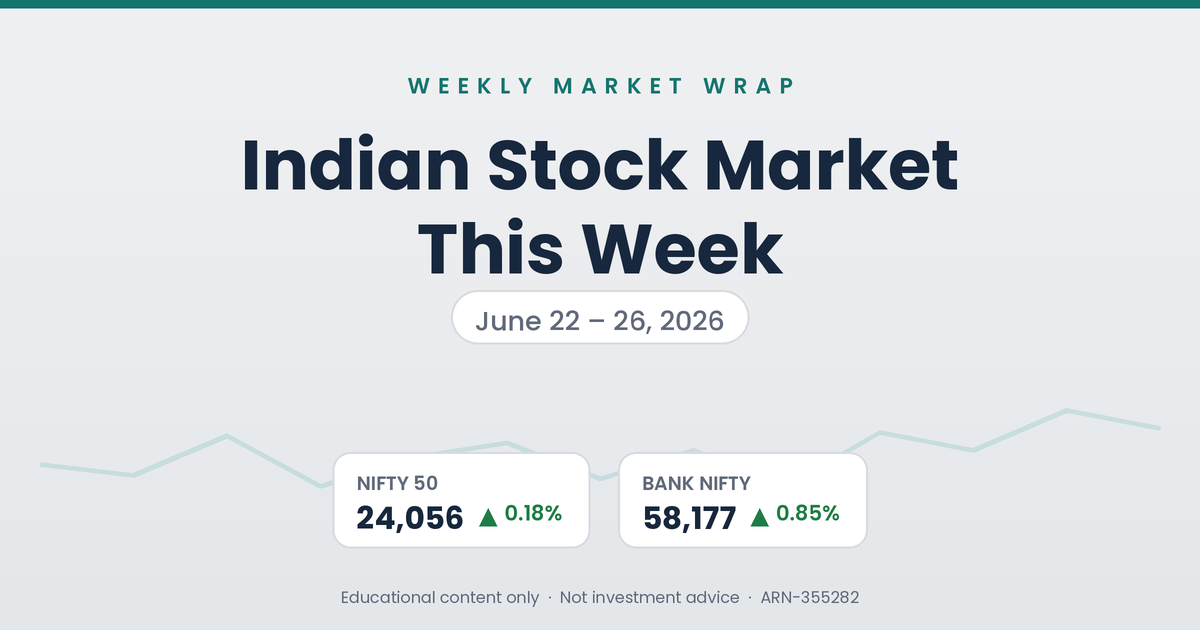
If you followed the Indian stock market this week, the headline looks dull: the Nifty 50 closed at 24,056, up just 0.18%. But a flat index can hide a lot of movement underneath.
Here’s a clear, beginner-friendly breakdown of what happened, why it happened, and what to keep an eye on as we head into a new week.
The scoreboard: where the indices closed
The Nifty 50 finished at 24,056 on Thursday, June 25. (Friday the 26th was a market holiday for Muharram, so it was a four-day week.) The Bank Nifty closed near 58,177, up about 0.85% — banking stocks were the week’s clear leaders.
Two details matter for a proper Nifty 50 weekly review. First, the index repeatedly tested the 24,200 zone but couldn’t hold above it. A level that a market struggles to cross is called a resistance — think of it as a ceiling where enough sellers step in to push prices back down.
Second, the broader market lagged: the midcap and smallcap indices each slipped about half a percent. In plain terms, the big, stable companies held firm while many smaller stocks fell — a sign of cautious, selective buying rather than a broad rally.
What moved the Indian stock market this week?
Three forces did most of the work.
Crude oil fell sharply. Brent crude slid back toward $73–75 a barrel as tensions in the Middle East eased and shipping routes reopened. India imports the bulk of its oil, so cheaper crude is a big positive — it lowers the country’s import bill, helps cool inflation, and directly cuts costs for fuel-heavy businesses like airlines and paint makers.
The RBI calmed nerves. The central bank’s Governor said it was “premature” to discuss raising interest rates, and the RBI eased some rules around lending against foreign-currency deposits. Lower-for-longer interest rates are good news for banks and borrowers, and the comment triggered a 791-point jump in the Sensex mid-week.
Global technology wobbled. Accenture — a global bellwether for the IT services industry — cut its revenue forecast, raising worries about how much the world will spend on technology. That kept Indian IT heavyweights under pressure all week, and a sharp fall in South Korea’s market added to the jitters.
Indian Stock Market This Week – Gainers and losers
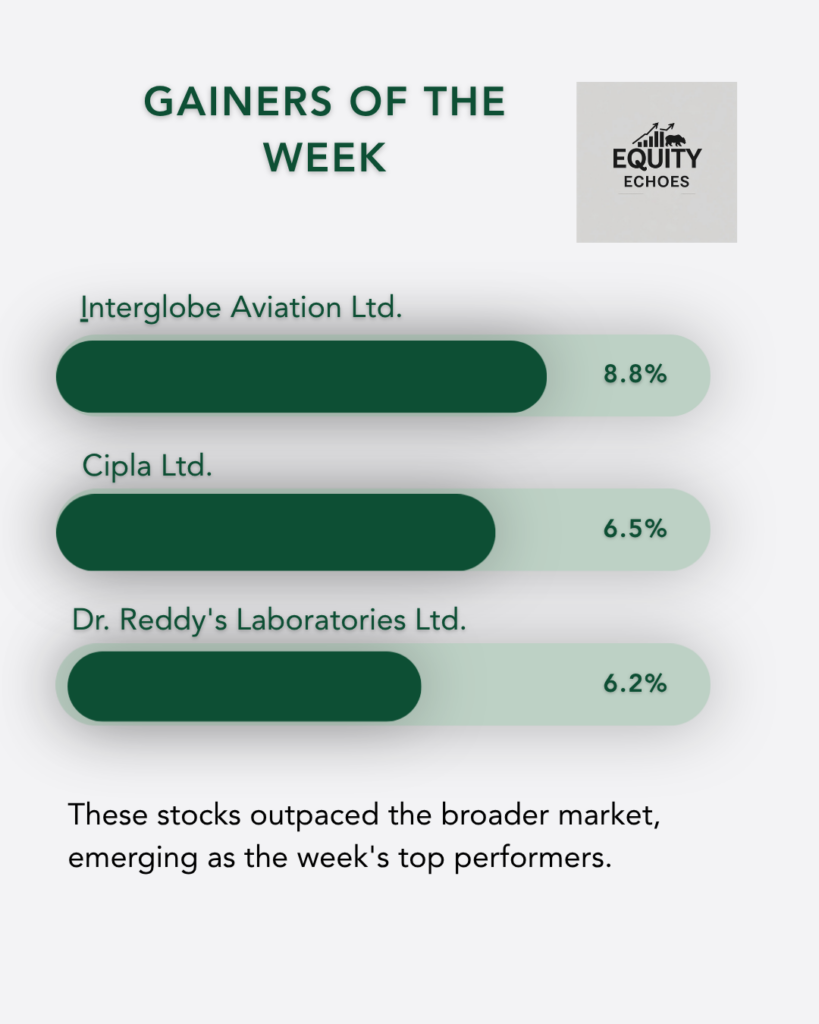
Among the gainers, IndiGo (InterGlobe Aviation) led the pack as falling jet-fuel costs brightened the outlook for airlines. Pharma names Cipla and Dr Reddy’s also rose — a textbook example of investors rotating out of a shaky sector (IT) and into a steadier, defensive one (healthcare).
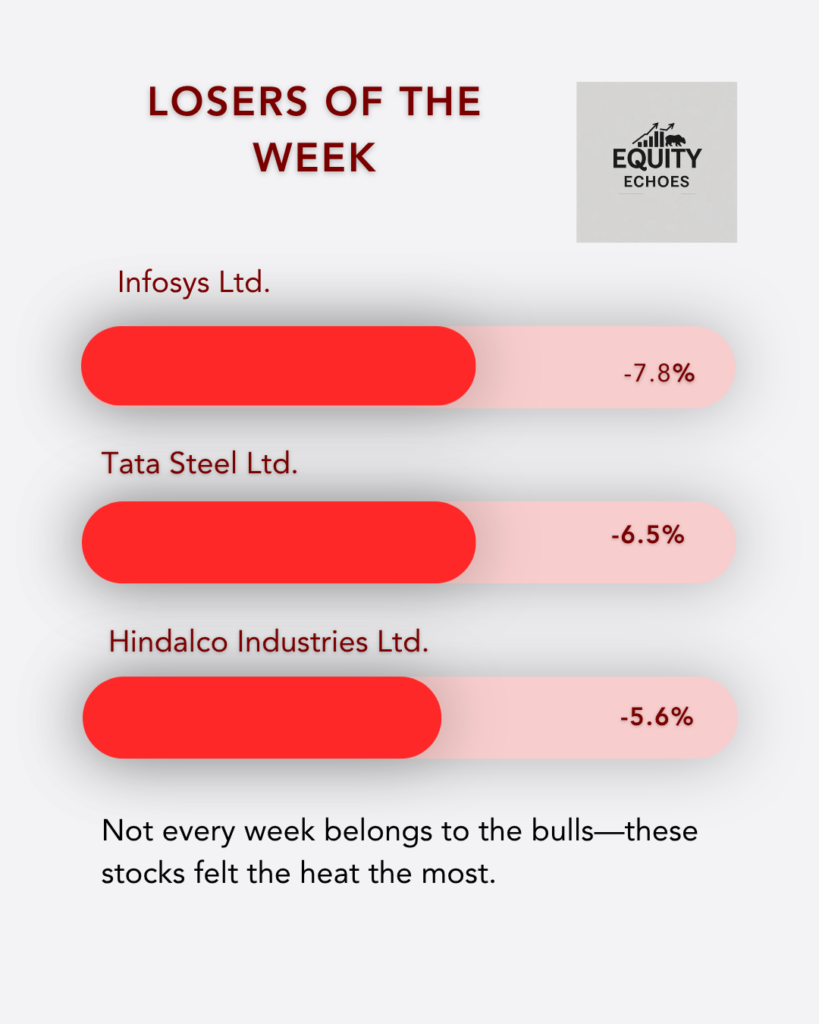
Among the losers, IT major Infosys stayed weak on the global tech concerns, while metal stocks Tata Steel and Hindalco fell on a stronger US dollar and softer global metal demand. A stronger dollar tends to pressure commodity prices, which hurts metal producers.
FII vs DII data for June 2026: who’s buying?
These two terms appear in every market report, so here’s the simple version.
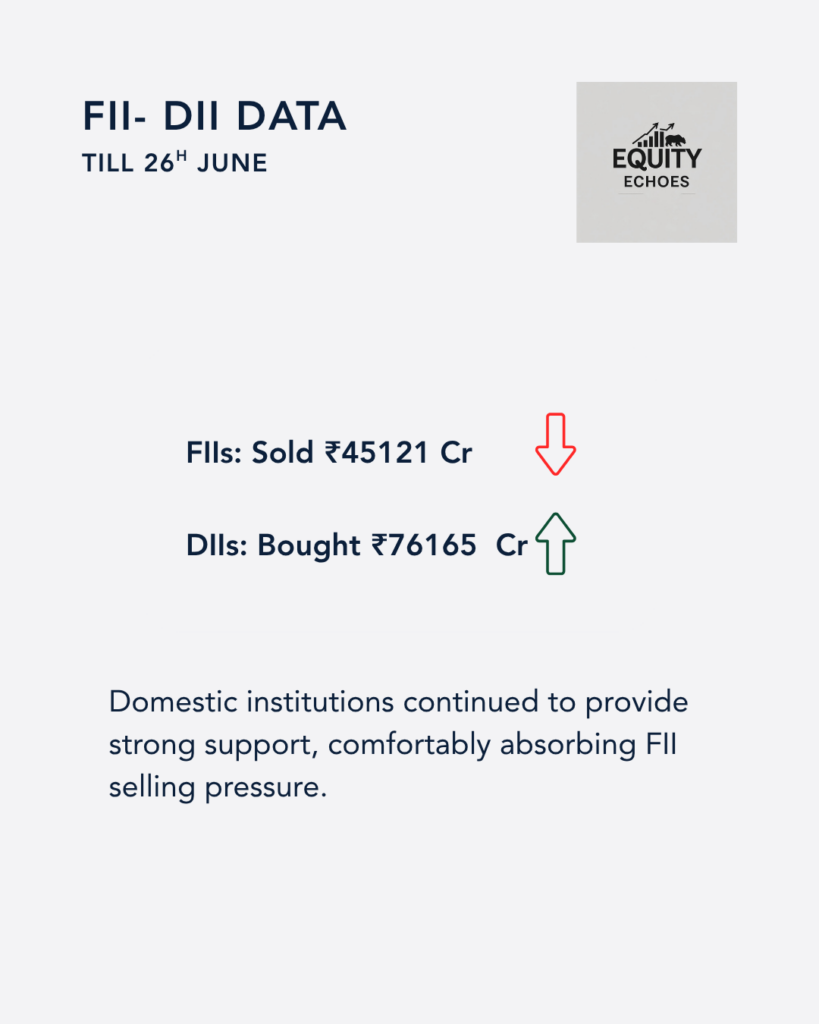
FIIs (Foreign Institutional Investors) are large overseas funds. DIIs (Domestic Institutional Investors) are India’s own mutual funds, insurance companies and pension funds. Looking at the FII DII data for June 2026, foreign investors were net sellers of roughly ₹45,000 crore, while domestic institutions net bought around ₹76,000 crore.
The takeaway for a stock market beginner: when foreign money leaves, strong domestic buying can absorb the selling and keep the market stable. That cushion — fuelled largely by steady monthly SIP inflows from ordinary investors — has been one of the defining features of Indian markets through 2026.
Market outlook: what to watch next week
Markets don’t move in a straight line, and nobody can predict the next move with certainty. But you can know what’s on the calendar and why certain themes are getting attention. Here’s the educational lay of the land — not a forecast, and not a recommendation to buy anything.
The data calendar
- IIP (Index of Industrial Production), due June 29. This measures output from factories, mines and power plants — a core read on industrial health. April’s reading grew 4.9%, with manufacturing up 6.2%. A strong number suggests the economy is humming; a weak one can dent sentiment.
- Monthly auto sales, early July. Vehicle sales are a real-time gauge of consumer demand. May’s passenger-vehicle numbers hit a record, up more than 25% year-on-year, helped by lower GST rates and easier loans.
Indian Stock Market This Week – Sectors in focus (and why)
Three areas are likely to stay in the headlines. Remember, “in focus” means worth understanding, not worth buying.
Pharma. When markets get nervous — as they did during this week’s IT scare — money often rotates into pharma because healthcare demand is steady regardless of the economy. Reports of global drug shortages that Indian firms could help fill have added to the sector’s spotlight. This “defensive” behaviour is exactly why pharma drew buyers this week.
Auto. With monthly sales data due, autos move from background to centre stage. The numbers will show whether the festive-and-financing-driven demand seen in May is holding up — a direct window into how confident ordinary consumers feel about spending.
Tourism and travel. Two threads come together here: the summer travel season, and the sharp fall in crude oil that lowers fuel costs for airlines (a big reason IndiGo rallied). Hotels, aviation and travel platforms tend to draw interest when travel demand and lower fuel costs line up.
The Takeaway: Understanding Sector Rotation
The biggest lesson from the Indian stock market this week is that a near-flat index can mask plenty of action. Money rotated out of IT and metals and into pharma and airlines — that’s sector rotation in action, and it happens constantly beneath the surface.
It’s also the simplest argument for diversification. When you hold a spread of sectors, a stumble in one (IT) can be offset by strength in another (pharma or aviation), and a scary headline becomes a non-event for your overall portfolio. Quiet weeks like this one are a useful reminder of why that balance matters.
Disclaimer: This article is for educational purposes only and is not investment advice. Always do your own research or consult a SEBI-registered adviser before making any investment decision. ARN-355282.
For daily updates, join our WhatsApp community – https://chat.whatsapp.com/BomPoCGduHtLFvVGPXssot?mode=gi_t
Subscribe our Youtube Channel – https://www.youtube.com/@equityechoess



Leave a Reply