

If 2025 taught investors one thing, it was this: markets don’t move in straight lines — but they always leave clues.
For me, this year was also special on a personal level. Equity Echoes, expanded beyond written content with the launch of its YouTube – Travel and Trades With Sakshi and Instagram page.
As I shared market insights across these platforms, over 5,000 new readers and viewers joined the journey, reaffirming that investors today value clarity, context, and calm explanations over noise.

For the Indian Stock Market, The year was full of ups and downs, policy headlines, earnings surprises, and global news that kept investors on their toes. Yet, despite all the noise, the Indian stock market showed resilience, with the Nifty holding firm near record levels by year-end.
This 2025 stock market review and 2026 outlook looks beyond index levels to understand sector performance, FII–DII flows, the rupee, gold, and silver — and what they collectively signal for the year ahead.
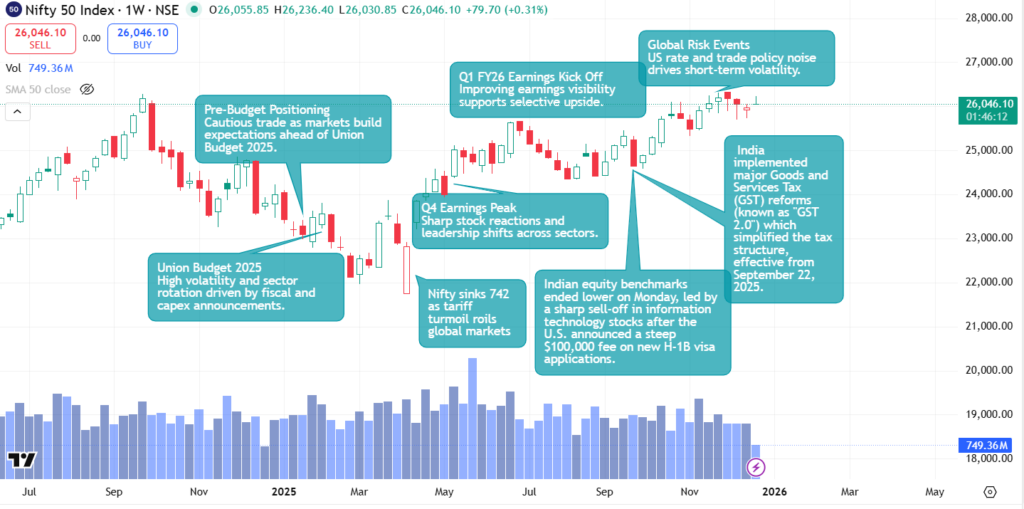
A Cautious Start to 2025 Before Conviction Returned
The year began on a careful note. Investors weren’t rushing in — they were waiting for clarity ahead of the Union Budget.
- Markets moved sideways
- Defensive and quality stocks were preferred
- Traders stayed light on positions
It wasn’t fear — just patience.
What it told us: Smart money waits when visibility is low.
Union Budget 2025: When Sector Leadership Began to Change
The Union Budget brought volatility, but it also brought direction.
Instead of chasing index levels, investors focused on sectors with real growth visibility.
Sectors That Gained Attention
- Banks & Financials: Credit growth stayed strong
- Capital Goods & Infrastructure: Long-term spending push
- Auto & Auto Ancillaries: Demand recovery and EV momentum
This early sector rotation laid the foundation for how markets behaved through the rest of the year.
Sector Performance in 2025: The Real Story Behind the Index
One of the biggest lessons of the 2025 stock market performance was clear: Not all sectors moved together.
Top Performing Sectors in 2025
Financials dominated the leaderboard in 2025, especially beyond traditional large banks.
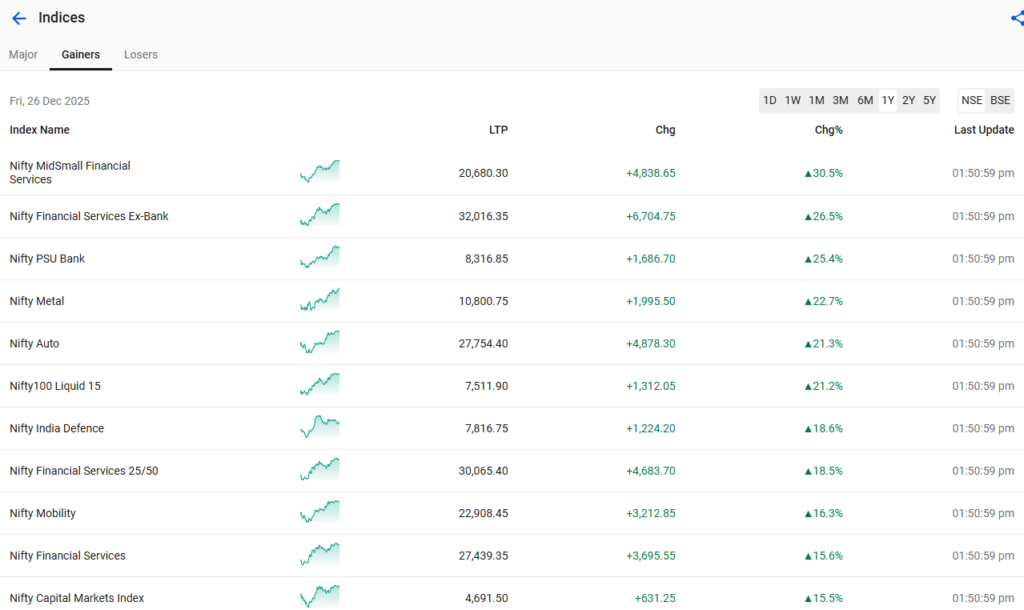
- Nifty MidSmall Financial Services surged over 30%, reflecting strong performance from NBFCs, housing finance companies, and niche lenders. Improving asset quality and steady credit demand played a key role.
- Nifty Financial Services (Ex-Bank) gained nearly 27%, showing that leadership extended beyond banks into insurance, asset management, and diversified financials.
- Nifty PSU Bank delivered a strong 25%+ return, as improving balance sheets, lower NPAs, and better profitability changed long-term investor perception.
- Nifty Metal rose over 22%, supported by global commodity price strength and selective margin improvement, though volatility remained high through the year.
- Nifty Auto climbed more than 21%, driven by robust SUV demand, improving rural sentiment, and continued interest in EV-linked names and auto ancillaries.
What this tells us:
2025 rewarded earnings-backed growth and balance-sheet repair stories, especially within financials and cyclicals.
Underperforming Sectors in 2025
Not all sectors shared the same momentum, and the laggards were equally clear.
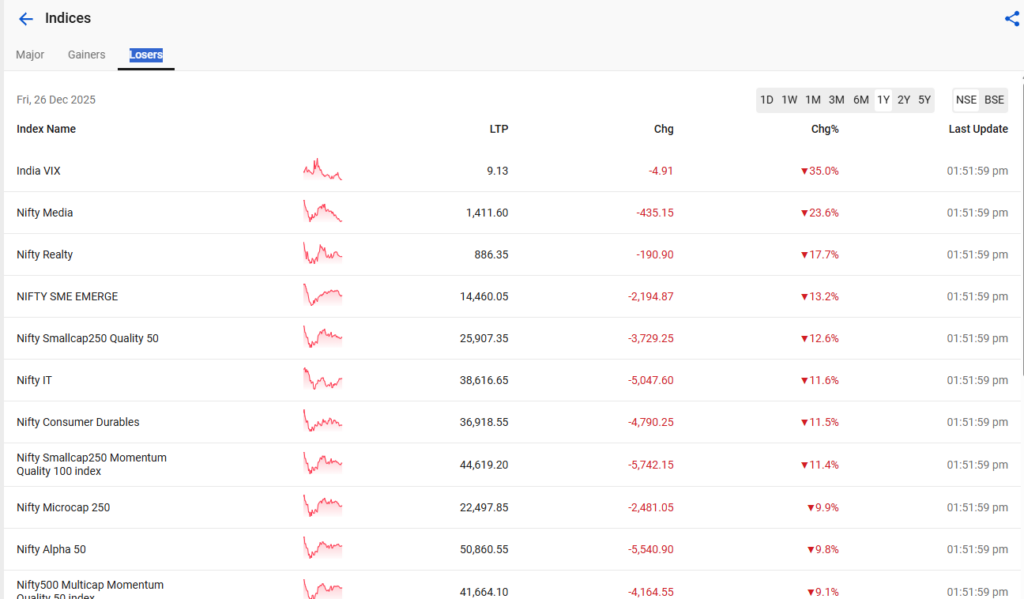
- India VIX fell nearly 35%, indicating a steady decline in market volatility as the year progressed. While negative on paper, this reflected growing investor confidence and reduced panic.
- Nifty Media declined over 23%, as advertising spends remained uneven and earnings visibility stayed weak.
- Nifty Realty dropped nearly 18%, weighed down by rising costs, selective demand, and profit booking after earlier cycles of outperformance.
- NIFTY SME Emerge slipped over 13%, highlighting how speculative and illiquid pockets struggled once liquidity tightened and risk appetite reduced.
What this tells us:
Sectors dependent on high leverage, weak earnings visibility, or excess speculation found it difficult to sustain momentum in 2025.
The sectoral picture of 2025 reinforces an important investing lesson:
Markets may rise, but leadership narrows as cycles mature.
- Financials proved to be the backbone of the rally
- Cyclical sectors worked selectively, not blindly
- High-risk segments underperformed once easy liquidity faded
This pattern is highly relevant while forming a disciplined 2026 outlook, where stock and sector selection will matter more than index direction.
FII and DII Flows: A Big Shift in Market Leadership
One of the most important trends shaping the 2026 outlook emerged clearly in 2025.
Foreign Institutional Investors (FIIs): Heavy Selling, Yet Markets Held Up
In calendar year 2025, FIIs were net sellers of nearly ₹2.96 lakh crore in Indian equities.
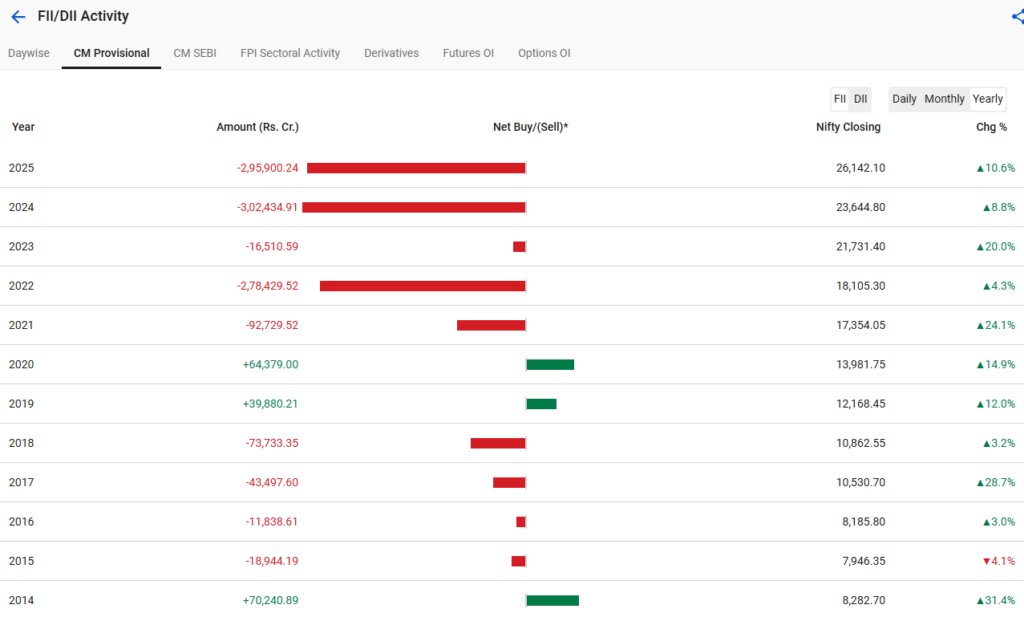
Despite this large outflow:
- The Nifty closed 2025 around 26,000 levels
- The index still delivered a positive return of about 10.6%
This clearly shows that while FIIs influenced short-term volatility, they did not control the market trend in 2025.
Why FIIs sold:
- Global interest rate uncertainty
- US dollar strength and global risk-off phases
- Better relative opportunities in other markets
Yet, the Indian market absorbed this selling remarkably well.
Domestic Institutional Investors (DIIs): The True Pillar of 2025
While FIIs were selling, DIIs stepped in aggressively.
In 2025, DIIs were net buyers of approximately ₹7.7 lakh crore, the highest annual domestic inflow on record.
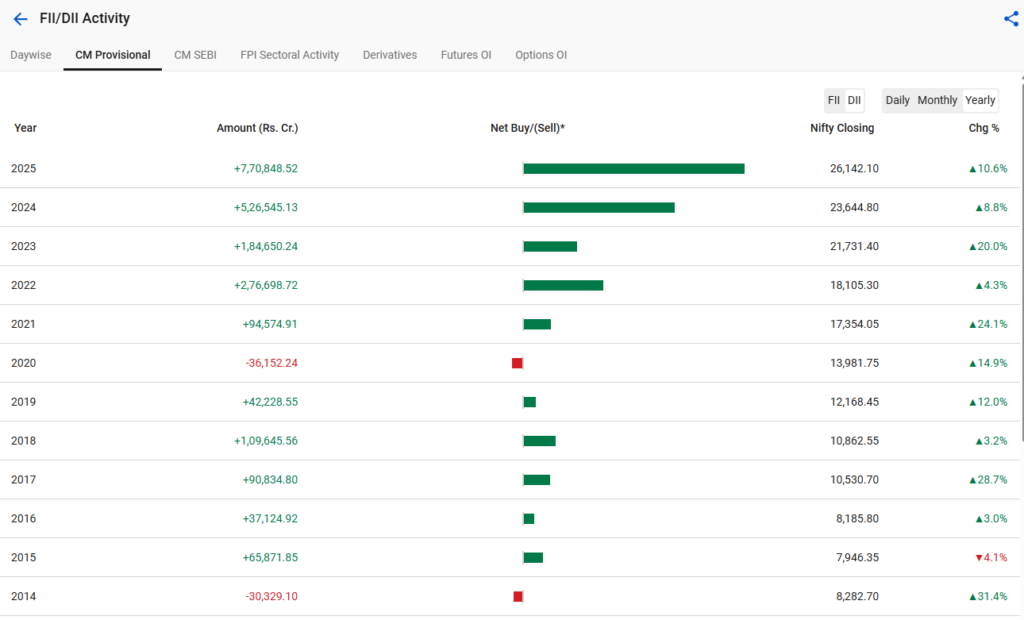
This buying was:
- Largely SIP-driven
- Spread across corrections and consolidations
- Focused on long-term fundamentals rather than short-term news
Looking at previous years only reinforces this trend:
- 2024: Strong DII buying alongside market gains
- 2023 & earlier: Consistent domestic participation during both bull and volatile phases
Simple truth:
Domestic investors didn’t just support the market in 2025 — they defined its strength.
The 2025 FII–DII data carries an important message for 2026:
- Indian markets are now less dependent on foreign flows
- Domestic savings and SIP culture provide a strong structural base
- Corrections driven by global selling are more likely to be opportunities than threats
When domestic money is patient and consistent, markets become more resilient.
Rupee Movement in 2025: Gradual Weakness, Nearing Historic Lows
The rupee’s journey in 2025 was marked by steady, controlled depreciation rather than sudden stress. As reflected on the USD/INR weekly chart, the rupee weakened gradually through the year and approached the 91 level — its all-time low zone.
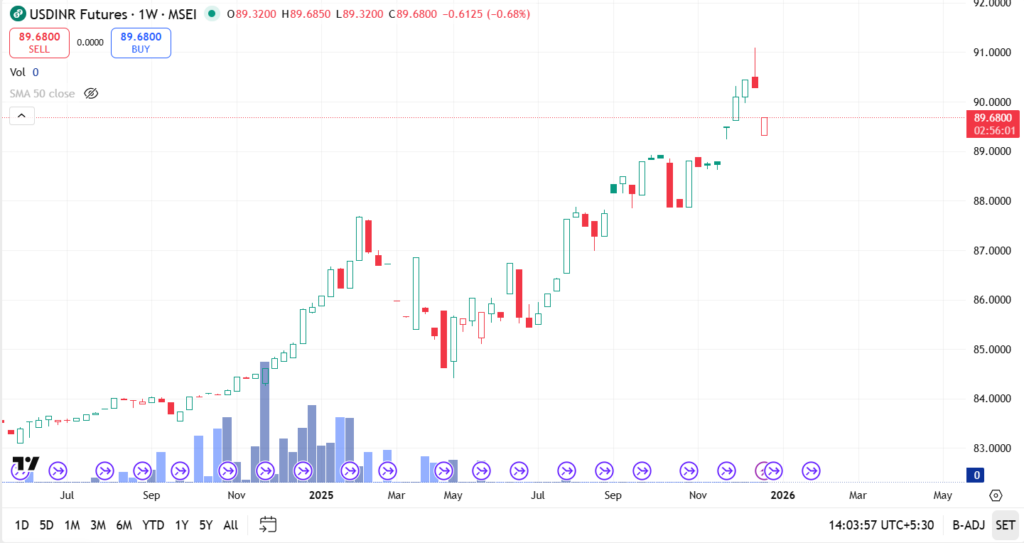
Importantly, this move unfolded over time, not in panic-driven spikes.
- USD/INR trended from the 83–84 range towards 89–90 levels
- The 91 zone acted as a historical extreme, closely watched by markets
- Price action remained orderly, indicating managed currency adjustment
This behaviour signalled macro pressure, not macro instability.
What This Means for Investors (and the 2026 Outlook)
- Gradual rupee weakness can coexist with equity market strength
- Export-oriented sectors benefit from currency tailwinds
- Sharp, fast depreciation would matter more than slow trends
A rupee near historic lows is a risk to watch, not a reason to panic.
Simple takeaway
In 2025, the rupee weakened and approached its all-time low near 91, but it did so calmly and in a controlled manner — allowing markets and businesses time to adjust.
Gold and Silver Performance: Silent Contributors to Portfolios
While equities stayed in focus, gold and silver quietly played their role.
Gold in 2025
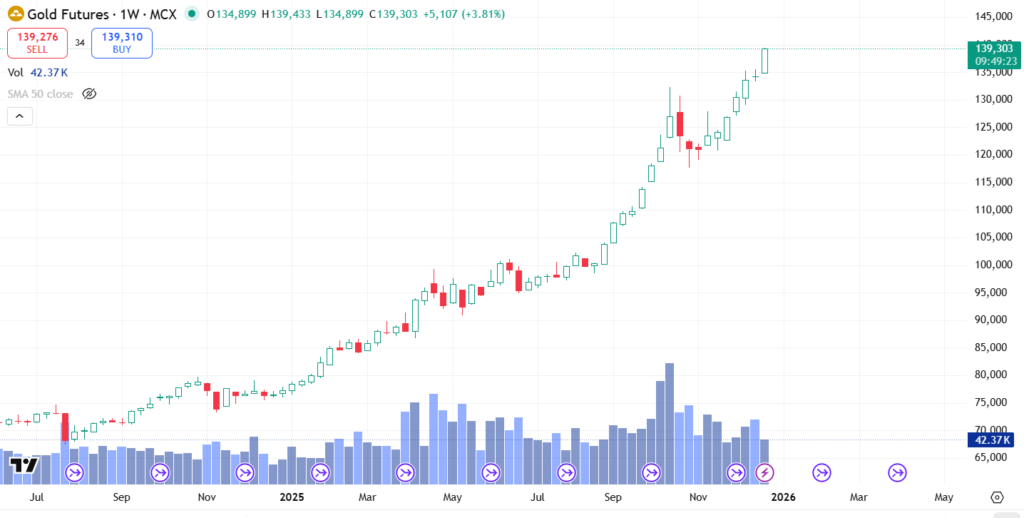
Gold turned out to be one of the quietly strong performers of 2025. As seen on the MCX Gold Futures weekly chart, prices moved in a clear higher-high, higher-low structure throughout the year.
- Gold started the year near the ₹72,000–75,000 zone
- The rally strengthened in the second half of the year
- By year-end, gold traded near ₹1,39,000, marking fresh all-time highs
Importantly, this move was gradual and well-supported, not a one-off spike.
- Provided stability during global uncertainty
- Acted as a hedge during equity corrections
- Reinforced its role as a long-term diversifier
Silver in 2025
If gold was steady and reassuring in 2025, silver was energetic and explosive.
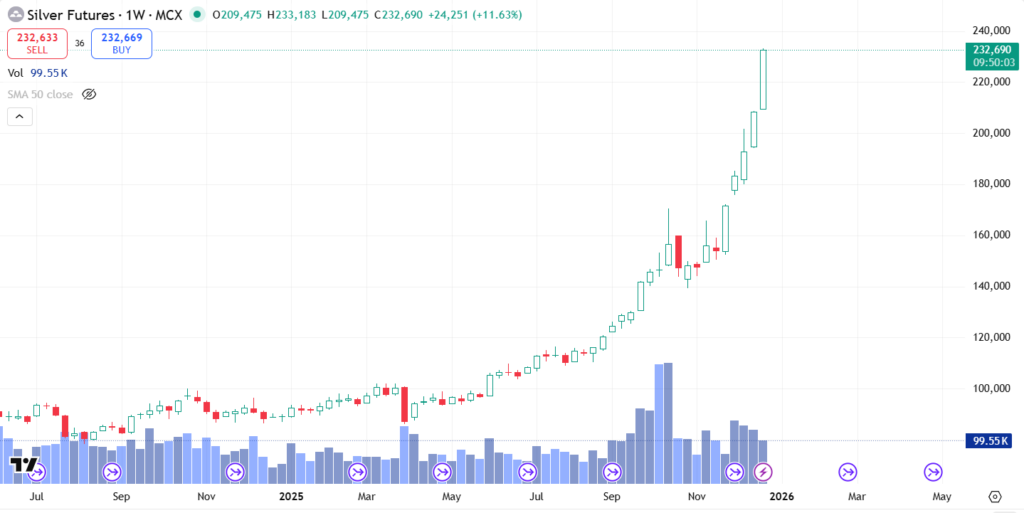
As seen on the MCX Silver Futures weekly chart, silver delivered a powerful breakout in the second half of the year, sharply outperforming many asset classes.
- Silver spent the early part of the year consolidating near the ₹85,000–95,000 zone
- Momentum picked up gradually mid-year
- A strong breakout phase followed, pushing prices to around ₹2,30,000+ by year-end
This wasn’t a slow grind — it was a high-momentum move backed by rising volumes.
- Benefited from industrial and green-energy demand
- More volatile than gold
- Better suited for tactical allocation
These trends continue to matter while building a balanced portfolio for the 2026 outlook.
Earnings Became the Real Market Driver
As 2025 progressed, markets matured.
- Companies delivering earnings were rewarded
- Weak balance sheets were punished
- Guidance and cash flows mattered more than stories
This earnings-led approach is likely to define market behaviour in 2026.
Global Factors and Their Role in the 2026 Outlook
Global events remained important but did not derail the market.
- US interest rate expectations
- Trade and tariff-related developments
- Currency and commodity volatility
These factors created short-term swings but did not change the long-term trend, reinforcing the importance of staying invested.
2026 Outlook: What Investors Should Focus On
Looking ahead, the Indian stock market outlook for 2026 is constructive but selective.
What Could Work in 2026
- Quality banks and financials
- Selective midcaps with earnings visibility
- Manufacturing, capex, and domestic growth themes
What to Be Careful About
- High valuations without earnings support
- Global macro shocks
- Chasing short-term narratives
The key to 2026: Stay disciplined, diversified, and process-driven.
Final Thoughts: From 2025 Performance to 2026 Preparedness
The journey from 2025 stock market performance to the 2026 outlook highlights one clear truth:
Markets reward calm, patient, and informed investors.
With strong domestic participation, improving earnings quality, and supportive long-term fundamentals, Indian equities remain well-positioned — even if volatility continues.
Disclaimer
This article is for educational purposes only and should not be considered investment advice. Please consult your financial advisor before making investment decisions.



Leave a Reply