

The January Effect is a well-known financial market anomaly observed in stock markets worldwide. It suggests that stock prices, particularly small-cap stocks, tend to rise in January, outperforming other months.

This phenomenon has been studied extensively in developed markets like the U.S., but does it hold true for Indian stock markets?
Keep Reading to know the details:
What is the January Effect?
The January Effect was first identified in the early 20th century and is attributed to several factors, including:
- Tax-Loss Harvesting: Investors sell underperforming stocks at the end of December to offset capital gains, creating downward pressure. In January, they reinvest, driving prices up.
- Year-End Bonuses: Fresh capital from bonuses is often invested in the market at the start of the year.
- Psychological Optimism: The beginning of a new year often brings optimism, encouraging investors to take positions in equities.
Evidence from Global Markets
Studies have shown that the January Effect is more prominent in smaller markets and among small-cap stocks. The phenomenon has diminished in developed markets over the years due to increased awareness and market efficiency, but it still holds sway in certain segments.
The Indian Context
India’s stock market has unique characteristics, including diverse investor profiles, regulatory differences, and cultural influences. While the January Effect is not as extensively studied in India as in the West, here are some observations:
- Small-Cap and Mid-Cap Performance: Indian small-cap and mid-cap stocks often exhibit greater volatility and price movement, potentially making them more susceptible to seasonal trends like the January Effect.
- FII and DII Activity: Foreign Institutional Investors (FIIs) and Domestic Institutional Investors (DIIs) play a significant role in India’s markets. Their January buying or selling patterns can amplify or negate the January Effect.
- Tax-Loss Selling: Indian investors also engage in tax-loss harvesting, but the fiscal year ends in March, not December. This timeline shift may dilute the classic January Effect in India.
Historical Performance of Indian Markets in January
An analysis of historical data for Indian stock indices like the Nifty 50 and Sensex shows mixed results. While some years witness strong January gains, others do not exhibit any significant outperformance.
Small-cap indices occasionally show higher returns in January compared to large-cap indices, suggesting some alignment with the global January Effect trend.
Below is a chart showing the historical performance of the Sensex and Nifty 50 in January from 2018 to 2024:
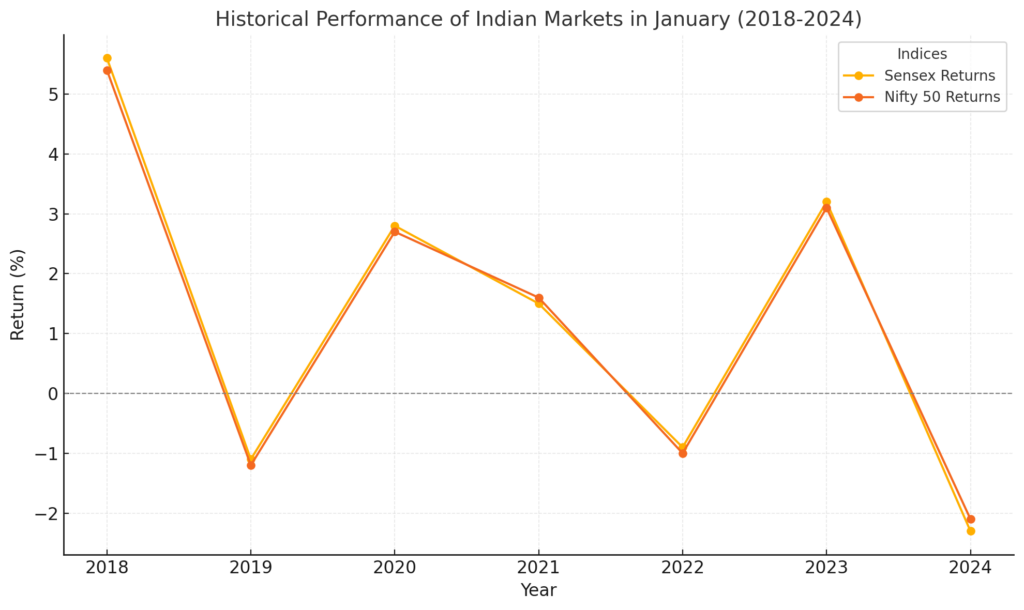
The data highlights the year-over-year returns for both indices, showing varying trends with some years experiencing gains and others recording losses:
- 2018: Sensex +5.6%, Nifty 50 +5.4%
- 2019: Sensex -1.1%, Nifty 50 -1.2%
- 2020: Sensex +2.8%, Nifty 50 +2.7%
- 2021: Sensex +1.5%, Nifty 50 +1.6%
- 2022: Sensex -0.9%, Nifty 50 -1.0%
- 2023: Sensex +3.2%, Nifty 50 +3.1%
- 2024: Sensex -2.3%, Nifty 50 -2.1%
- 2025: Sensex -0.97%, Nifty 50 -0.9% (till 12.1.2025)
The chart and data reveal that while certain years have shown strong January gains, others have not exhibited significant outperformance, suggesting that the January Effect in India is inconsistent and influenced by varying factors.
However, we may see negative returns in January 2025
Current Reasons for Indian Stock Market Decline
The Indian stock market has been experiencing a downturn recently. Here are five key reasons contributing to this trend:
- Global Cues and Macroeconomic Factors:
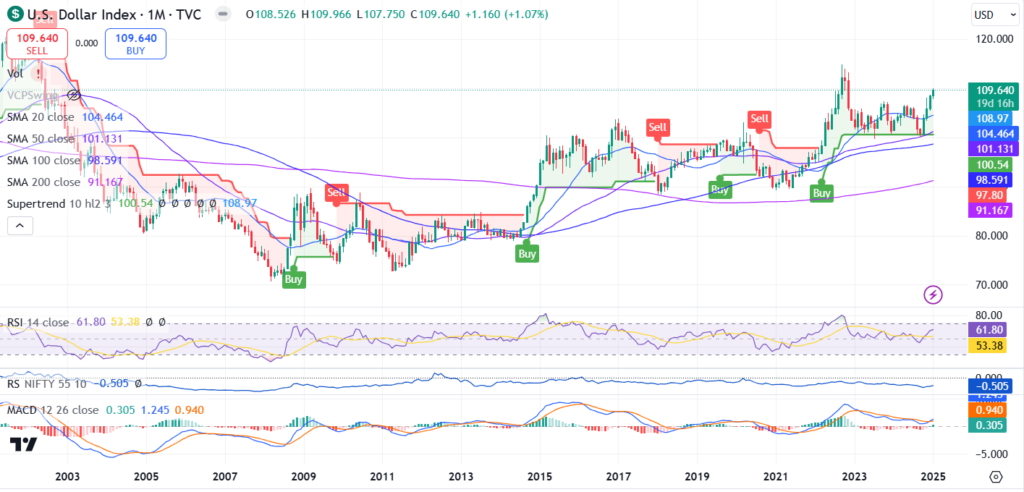
Rising US Bond Yields: When US Treasury yields rise, it makes US bonds more attractive to global investors, including FIIs. This can lead to outflows from emerging markets like India, putting downward pressure on Indian stock prices.
A stronger US dollar can also lead to FII outflows, as it becomes more expensive for them to invest in emerging markets.
2. FII Outflows:
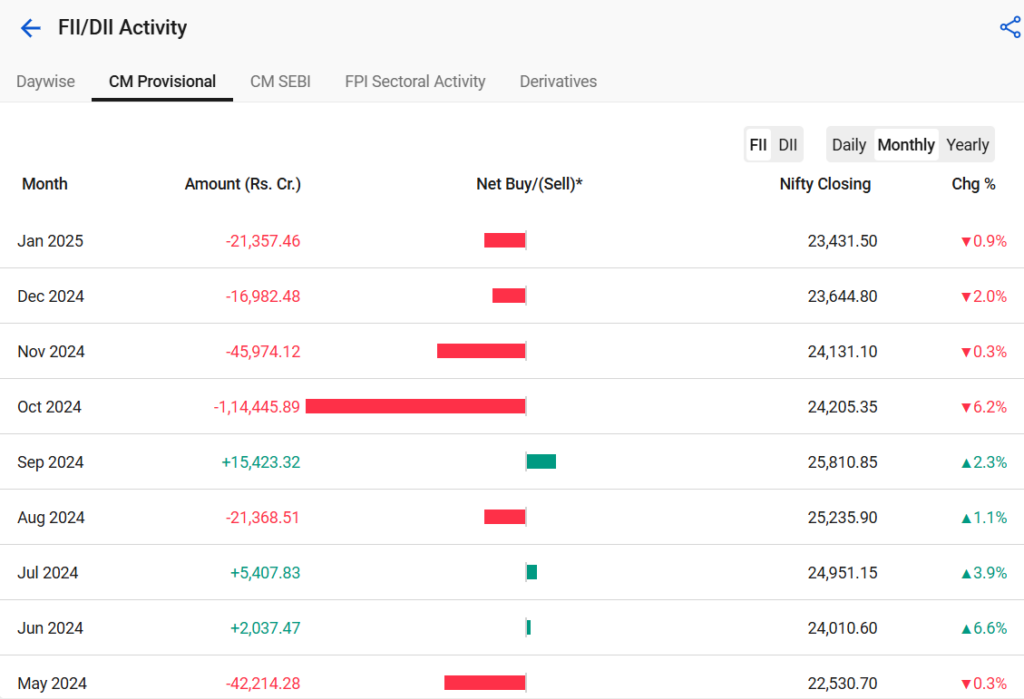
Foreign Institutional Investors have been net sellers in the Indian equity market, withdrawing significant capital due to global risk aversion.
In the first week of January 2025, FIIs sold shares worth ₹21,353 crore, while Domestic Institutional Investors (DIIs) purchased shares worth ₹24,216 crore, indicating a net outflow from FIIs.
3. Inflation:
While India’s economic growth is still relatively strong compared to other major economies, there might be some concerns about a potential slowdown or challenges in achieving the projected growth rates.
If inflation remains persistently high, it could lead to further interest rate hikes by the RBI, which can negatively impact corporate earnings and market sentiment
4. Weak Q3 Earnings:
Disappointing quarterly results from major companies, especially in sectors like IT and FMCG, have weighed on market performance.
5. Crude Oil Price Volatility:
Fluctuating crude oil prices have raised concerns about inflation and the fiscal deficit, pressuring the Indian rupee and equity markets.
Does It Truly Hold?
The January Effect is not a guaranteed phenomenon in the Indian stock market. Its presence, when observed, is often influenced by external and internal market conditions.
Unlike developed markets, where the January Effect has been systematically studied, India’s unique calendar and market dynamics make it less predictable.
What Does the Current Market Breadth Indicate?
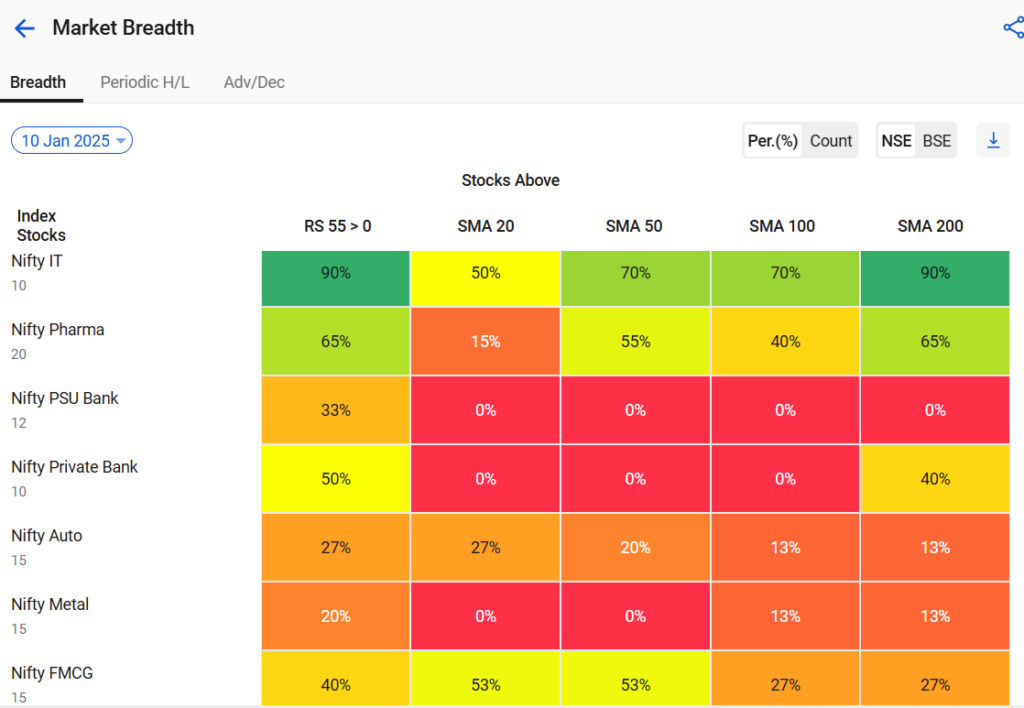
Sectoral analysis shows strong performance in sectors like IT and pharmaceuticals which have recorded the highest percentage of advancing stocks. This indicates sector-specific momentum, potentially driven by favorable policies, earnings results, or macroeconomic conditions.
In contrast, automobiles, industrial manufacturing, and financial services are witnessing subdued performance with a higher number of declining stocks.
Takeaways for Investors:
- Avoid Overgeneralization: While the January Effect may occur, it should not be the sole basis for investment decisions.
- Focus on Fundamentals: Align investments with long-term goals and sound analysis rather than relying on seasonal trends.
- Keep an Eye on Small Caps: If the January Effect holds, small-cap stocks might show greater upward momentum, presenting opportunities for higher returns.
- Monitor Market Sentiment: January often sets the tone for the year; staying updated with market cues is essential.
Conclusion
The January Effect in Indian stock markets remains a subject of debate. While some patterns align with the global phenomenon, India’s unique characteristics make it inconsistent and less pronounced. Investors should approach the concept cautiously, focusing on broader market trends and fundamentals to make informed decisions.



Leave a Reply