

The Union Budget 2026–27 sets the tone for India’s next phase of economic expansion, balancing growth, fiscal discipline, and long-term capacity building. Presented by Finance Minister Nirmala Sitharaman in her ninth consecutive Budget, this year’s policy roadmap is firmly aligned with the government’s vision of Viksit Bharat.
Rather than focusing on short-term stimulus, the Union Budget prioritises structural reforms, strategic investments, and execution-driven growth. Manufacturing, infrastructure, MSMEs, and technology-led sectors emerge as the biggest beneficiaries, while fiscal consolidation remains firmly on track.
This blog offers a sector-wise analysis of Union Budget highlighting where policy support is strongest and what it means for businesses, investors, and the broader economy.
Overview of Union Budget 2026–27
At a macro level, the Union Budget reinforces confidence in India’s economic trajectory:
- Fiscal deficit targeted at 4.3% of GDP
- Debt-to-GDP ratio improving to ~55.6%
- Capital expenditure raised to ₹12.2 lakh crore
- Continued focus on ease of doing business and compliance simplification
The Budget is guided by three key responsibilities:
- Accelerating and sustaining economic growth
- Empowering citizens through skills, employment, and productivity
- Ensuring inclusive development across regions and communities
Pharma, Healthcare & Biopharma Sector
The pharma and healthcare sector receives strong long-term support in the Union Budget with a clear shift toward innovation-led growth.
Key Highlights
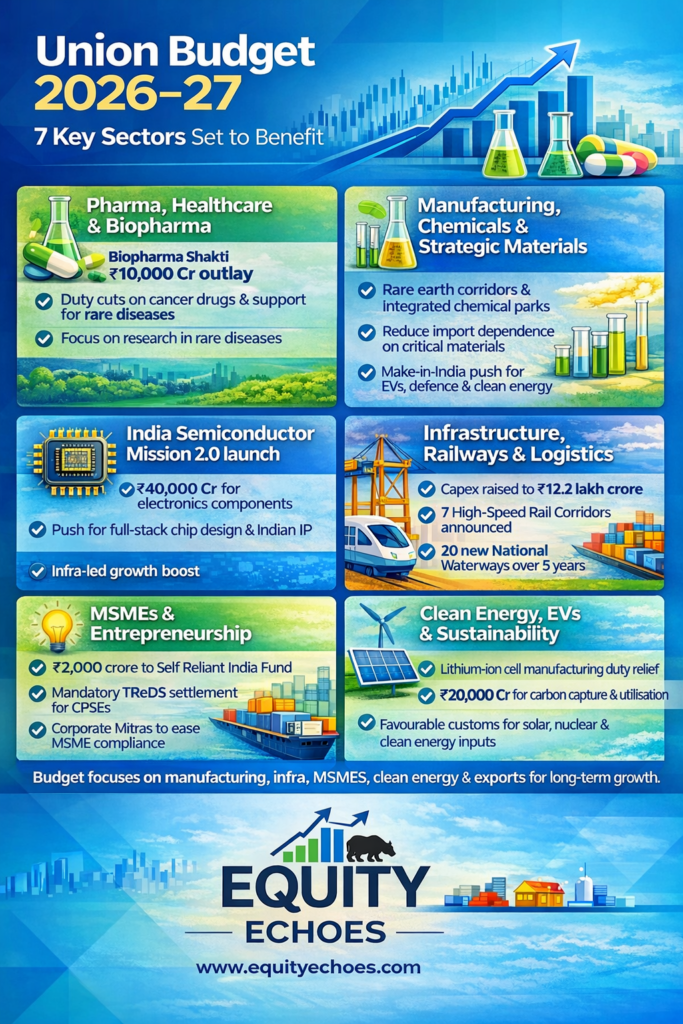
- Biopharma Shakti launched with a ₹10,000 crore outlay
- Focus on research, advanced manufacturing, and innovation
- Strengthening biopharma infrastructure and supply chains
- Customs duty exemption on 17 cancer drugs
- Expanded support for rare diseases
Sector Impact
The Union Budget 2026–27 aims to move India beyond generics and position it as a global biopharma hub. Lower input risks, stronger R&D support, and healthcare affordability measures make this a structurally positive sector.
Manufacturing, Chemicals & Strategic Materials
Domestic manufacturing and supply-chain resilience remain central to the Union Budget
Key Highlights
- Rare earth corridors and integrated chemical parks proposed
- Reduced import dependence on critical materials
- Support for EVs, electronics, defence, clean energy, and pharma
Sector Impact
By strengthening access to strategic materials, the Union Budget reduces geopolitical and cost risks while improving global competitiveness for Indian manufacturers.
Electronics & Semiconductor Push
India’s ambition to become a global electronics and semiconductor hub gains momentum
Key Highlights
- Launch of India Semiconductor Mission 2.0 (ISM 2.0)
- ₹40,000 crore outlay for electronics component manufacturing
- Focus on equipment, materials, full-stack chip design, and Indian IP
- Support for industry-led research and skilled workforce development
Sector Impact
The Union Budget moves India deeper into the semiconductor value chain, beyond assembly into design, materials, and intellectual property creation.
Infrastructure, Railways & Logistics
Infrastructure continues to be the backbone of growth in the Union Budget
Key Highlights
- Capital expenditure increased to ₹12.2 lakh crore
- Announcement of 7 high-speed rail corridors
- Plan to operationalise 20 new National Waterways over five years
- Coastal cargo promotion and seaplane connectivity
- Infrastructure Risk Guarantee Fund to support private investment
Sector Impact
Sustained infra spending improves logistics efficiency, supports employment, and crowds in private capital. The Union Budget 2026–27 reinforces infrastructure as a long-term growth multiplier.
MSMEs & Entrepreneurship
MSMEs receive targeted and practical support in the Union Budget focusing on cash flow certainty and compliance ease.
Key Highlights
- ₹2,000 crore top-up to the Self Reliant India Fund
- Mandatory TReDS settlement for CPSE purchases from MSMEs
- Credit guarantee support for invoice discounting
- Integration of GeM with TReDS
- Introduction of Corporate Mitras for compliance support
Sector Impact
The Union Budget strengthens MSMEs by addressing working capital delays, regulatory complexity, and access to risk capital—key factors for sustainable growth.
Clean Energy, EVs & Sustainability
India’s energy transition receives continued policy backing in the Union Budget
Key Highlights
- Customs duty relief for lithium-ion battery manufacturing
- Relief for solar glass inputs
- Customs exemptions for nuclear power projects extended till 2035
- ₹20,000 crore outlay for carbon capture and utilisation
Sector Impact
Lower input costs and long-term visibility support investments in renewables, EVs, and clean energy manufacturing under the Union Budget 2026–27.
Exports, Textiles & Labour-Intensive Sectors
The Union Budget 2026–27 also supports export-oriented and labour-intensive industries.
Key Highlights
- Export incentives for seafood, leather, and textiles
- Increased duty-free import limits for seafood processing inputs
- Footwear exports extended to include shoe uppers
- Customs duty alignment for simpler compliance
Sector Impact
These measures improve cost competitiveness, support employment generation, and strengthen India’s export engine.
Tax, Compliance & Ease of Doing Business
The Union Budget 2026–27 simplifies compliance while improving cash flows:
- Reduced TCS on overseas tour packages
- No TCS on education and medical remittances
- Easier ITR timelines and extended revision window
- Faster, trust-based customs clearance framework
Final Takeaways from Union Budget 2026–27
The Union Budget 2026–27 is a long-term, execution-focused Budget. It prioritises:
- Manufacturing scale-up
- Infrastructure-led growth
- MSME resilience
- Technology and clean energy transition
- Fiscal discipline with policy continuity
Rather than chasing short-term market reactions, the Union Budget 2026–27 lays a stable foundation for sustainable economic growth over the coming decade.
FAQs
What are the key focus areas of Union Budget 2026–27?
The Union Budget 2026–27 focuses on manufacturing, infrastructure development, MSME support, clean energy, healthcare, technology, and fiscal consolidation.
Which sectors benefit the most from Union Budget 2026–27?
Pharma, infrastructure, MSMEs, electronics, clean energy, and export-oriented sectors emerge as key beneficiaries.



Leave a Reply